


After the Fall
Part One of a Special In-Depth Series
by Stacy Schroeder
[Originally published in the Fall 2026 issue of Mount Gretna Magazine. View the complete issue to experience this story in its original design, along with additional photographs and content.]

For more than 130 years, Mount Gretna’s Playhouse has anchored the community. Destroyed by fire in 1898 and rebuilt, it suffered another devastating blow when its roof collapsed in February 1994.
What follows is a window into that chapter of the Playhouse’s history, drawn from original documents, photographs, and other contemporary materials. Their depth and detail made it possible to tell the story largely from the perspective of those experiencing it in real time, while keeping the chronology of an extraordinarily layered narrative intact — one that could easily fill a book.
Why cover this story now?
Management of the Playhouse is about to change for the first time in 30 years. Chautauqua leadership will resume oversight when the Mount Gretna Arts Council’s operating lease expires next month. (This story was published in October 2026.)
A new fundraiser for the Playhouse is in progress.
And perhaps most importantly, enough time has passed to see that the heart of the story is not the building’s collapse.
It is how the crisis invited our community to wrestle with what it means to live and work together — questions that still resonate today.
The crisis begins
The winter of 1994 tested much of the northeastern United States. By February 1994, storms had piled 18 inches of snow and ice — an estimated 150 tons — on the Playhouse’s conical roof. Loud cracking sounds from its supporting trusses were first noted on Feb. 9 that year.
“We had a crew ready to go up and take the snow off,” said Bill Care, Mount Gretna Borough’s Superintendent of Public Works, to the Lancaster New Era, “but they [engineers] would not let us.”
By Thursday evening, Feb. 11, three workers from a local contracting firm — suspended above the Playhouse by one of the largest cranes in the area — worked to reduce the load. Once deemed safe, a dozen employees climbed onto the roof to shovel, fueled overnight by the well wishes of passersby and hamburgers brought over from the local restaurant The Mount Gretna Hide-a-way. This plan may have succeeded were it not for a Friday storm that added over another 8 inches of snow.
Care and other leaders were back on-site early Saturday morning, Feb. 12, not long before the auditorium of the Playhouse fell. “The support posts all went outward, and it dropped right straight down,” Chautauqua secretary Dale Grundon told the Lancaster New Era.
Becky Reed, whose cottage was located less than 100 feet away, described the event to the Patriot News. “It sounded like a mighty, rushing wind. Ten seconds — it was down,” she said.
“It smells old,” she added later, “like the perfume that’s floating out of the cottages in the summer when somebody’s sitting out on the porch.”
Hope reigns
Three days later, leaders hosted a Playhouse revival meeting at Gretna’s Timbers Restaurant and Dinner Theatre. About 150 people showed up. “It’s kind of a wake for all our people to get together,” Chautauqua vice president Chuck Allwein told the Lancaster New Era. “We want to give the community — not just the Mount Gretna community, but the entire tri-county area — an opportunity to express what they want to express.”
Chautauqua’s Board, which had been closely following the situation, had already convened an emergency session that established a slate of new targeted committees that included contingency, architectural design, and fundraising. That night, they shared that the Playhouse’s stage and restrooms were salvageable, with a tent being sought as a temporary replacement “roof.” A small but inspiring piece of good news also emerged: Care had found and saved the Playhouse’s finial. There was optimism in the room, with some embracing the opportunity to build something grand to last another 100 years.
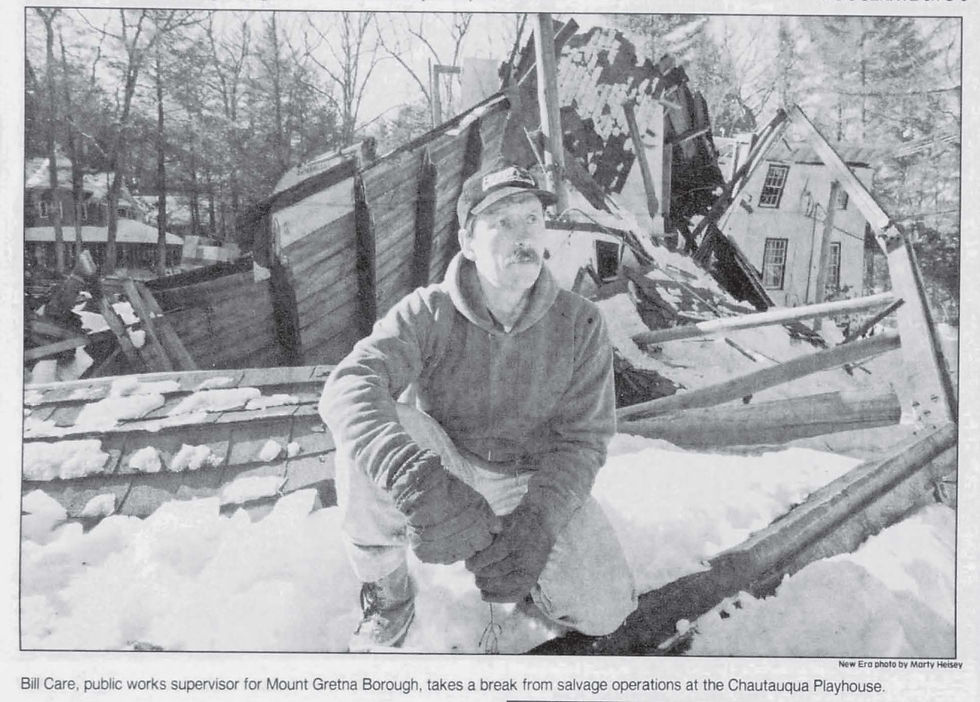
In these early days, volunteer teams climbed through the rubble for artifacts, local theaters and high schools offered to host fundraisers, and newspaper coverage briefly extended across the country, thanks to an Associated Press piece.
By March, contingency committee chair Cynthia Condrack had secured two connected tents for the summer, providing seating for roughly 800, comparable to previous years. Gretna Theatre and Gretna Music, the two cultural organizations that rented the Playhouse, could now confidently move forward with ticket sales for their upcoming seasons. Mobile trailers would provide dressing rooms and a box office while the existing stage and restrooms would be reused.
Meanwhile, Chautauqua leaders worked to develop a design and find funding for the new building. They adopted “Rebuilding Gretna’s Glory” as the campaign motto.
Allwein, named as chair of the new architectural design committee, was encouraged to have his group brainstorm the “big footprint” design. As the committee gathered ideas from tenants, community leaders, and one another, the vision for the new Playhouse expanded.
In early March 1994, letters were sent inviting seven architectural firms to submit designs. Those competing for the bid were encouraged to go big, incorporating seating for up to 1,000 with modern backstage facilities tailored as much as possible to both tenants’ requests. They also faced an ambitious deadline: The building had to be ready for the summer of 1995 without disrupting performances already scheduled for the summer of 1994.
Leading through a crisis
The Board faced a trifecta of complications: a tight schedule, intense public scrutiny, and constantly evolving information. Meeting minutes reflect a push and pull between deadline-driven action and time for visioning and broader community engagement. That tension surfaced in several ways. Gretna Theatre and Gretna Music, for example, sought a greater voice in the planning process, while individuals also weighed in with letters of both support and concern.
Doug Bedell, chair of the public relations committee, was one of those writers. He shared his thoughts at a special March 30 Board meeting. Bedell was no stranger to navigating complex public crises. Fifteen years earlier, he had served as spokesperson for the Three Mile Island cleanup effort. He now held up issues he felt needed to be considered, including community perceptions and desires.
Bedell asked these questions: Do we build to serve the community or a wider circle? Does being better necessarily mean being bigger? Do we want to be more than a summer place? Will the Playhouse be self-sustaining? How can we extend our support base?
The Board subsequently invited Bedell and representatives from Gretna Theatre, Gretna Music, and the Mount Gretna Arts Council to a facilitated visioning retreat in April 1994. They had already begun refining their process, including appointing a steering committee to better coordinate efforts.
Now they paused in this larger group to share memories of the Playhouse and to name opportunities and challenges around the rebuilding project. It was noted that it might not be possible to meet all the design hopes without increasing costs. Allwein pointed out that the two tenants had considerably different needs. Shopping the “big footprint” was once again encouraged, however, to excite donors and see if the money was there.
“I’ve been very impressed today. We spoke openly and freely,” Chautauqua president Karl Gettle said at the end of the retreat. “Continue to work together, work openly, continue to get true feelings out. Make a mistake, pick it up, go forward.”
Following the April retreat, the Board hired several part-time staff — Condrack in administration and Bedell in public relations. A small office was also established on the second floor of the Chautauqua Lodge above Barb’s Buns (now Porch and Pantry).
Hidden costs
That spring, Chautauqua leaders discovered that rebuilding the Playhouse required far more than replacing its roof. It also meant examining nearly every associated budget item and transaction.
A new building promised substantially higher operating costs without any meaningful increase in rental income. Annual property taxes alone could rise from nominal amounts on the former structure to more than $37,000 on a $2 million facility, with insurance premiums also climbing. Leaders explored whether transferring ownership to either the Mount Gretna Authority (an entity connected to Mount Gretna Borough) or the Arts Council might avoid property taxation altogether, but neither option proved viable.
Questions also arose about the settlement from the insurance claim. The Board believed the company’s $231,000 valuation may have undervalued the Playhouse and even considered legal action before deciding against it.
At the same time, the leaders examined whether the Chautauqua itself could be reorganized as a nonprofit to make donations tax-deductible. The concept advanced as far as a stockholder vote on a related bylaw item before ultimately being abandoned. However, the idea would later reemerge in the creation of the Pennsylvania Chautauqua Foundation in 2001.
Meanwhile, the fundraising timeline was becoming urgent. Some wanted to capitalize on public goodwill and begin fundraising immediately, but a campaign required both a finalized design and a tax-deductible way to accept gifts. The Arts Council offered to serve as a temporary fundraising arm while those questions were resolved, and in late spring, the Board hired a Lancaster fundraising firm to guide them in launching the campaign.
Imagining a new Playhouse
By early summer 1994, at least 29 leaders and 47 volunteers were actively involved in the rebuilding effort. While work continued on many fronts, one task rose above the rest: defining what the new Playhouse should become. Without that vision, fundraising could not begin in earnest, and construction needed to start by September if reopening for the summer of 1995 was to remain possible.
Five firms submitted proposals ranging from $1.2 million to $4 million. Some would have rerouted Pennsylvania Avenue or permanently closed Carnegie Avenue. One member of the architectural committee described the most ambitious design as a “$4 million jewel that would be noticed in New York” while another coined it “an architectural monstrosity.”
The architectural committee selected two finalists to present to the Board. However, when it came time to choose, only the $2.5 million proposal from a two-firm partnership based out of Baltimore and Harrisburg remained. Gretna-affiliated architect Philip Johnston, the other finalist, had withdrawn his firm’s proposal, believing the project had grown too large.
To gauge public reaction, Chautauqua leaders scheduled a June 8-9 unveiling of these plans at the Playhouse site. Multiple local papers covered the event in glowing terms, declaring that the design kept the charm of the previous building and incorporated appreciated amenities. Several locals, including the mayor’s wife, are quoted as giving personal approval.
The Board said it was waiting on community response to move forward. “We want input from all the people — this is our intent,” said Gettle to the Intelligencer Journal. “They can come and talk to various people, and ask, ‘Why this, why that?’” Plans were “pretty solidified” but subject to minor adjustments based on resident feedback.
Publicly, the rebuilding effort appeared to be moving forward.
A turning point
Despite this promising debut, a study conducted that same month by the hired fundraising firm ground progress to a halt. Thirty community leaders and potential major donors had been approached. Their confidential responses, later leaked to the Lebanon Daily News, challenged assumptions upon which leadership had been working.
It showed support of a rebuild: “Without a playhouse, the Mount Gretna community will decline. It would be like having a puzzle with one piece missing,” one respondent stated.
But those responses also identified a local $750,000 fundraising capacity, with concurrent regional campaigns limiting outside monies. “The design is far too ambitious for this community,” another respondent noted.
Moving forward required better communication and inclusion in decision-making. “Why are they asking my opinion now? Why didn’t they ask before they made all the decisions?” someone commented.
One-third (10) of those interviewed asserted a general mistrust of Chautauqua’s leadership to manage the project. “All of Mount Gretna will never come together around a building owned by the Chautauqua,” one commenter stated.
For the volunteer leaders who had invested significant hours responding to the crisis, the findings stung. For those who had felt excluded, the study offered a voice.
“While the results hurt those who have been working hard,” said Bedell at a meeting of the architecture committee, “info can now be used going forward.”
Throughout July, Chautauqua leaders discussed how to incorporate these findings. Should they slow down and start over, as the report suggested? Had enough people been polled to trust the results? Were there ways to adapt what had already been accomplished? Allwein shared that costs might be able to be trimmed to $1.75 million or possibly even $1.5 million. The architectural committee had stopped the bidding process to avoid accruing more expenses while next steps were deliberated.
On July 23, the steering committee recommended that the Board and the Arts Council explore making the Arts Council the organizing hub for a new group that would oversee planning for a new Playhouse.
However, minutes from an architectural committee meeting soon after note, “The Arts Council does not seem anxious to take over the project, and it is not known if the Chautauqua Board would be willing to relinquish control.”
“The Chautauqua is the most important entity of Gretna and the driving force behind many projects,” said Arts Council president Tom Clemens at the Board’s meeting in late July. “However, the Board of Managers [has not] recognized that Chautauqua is only 25% of Gretna and that other residents may not feel the need to donate to this project.”
The press got wind of the study in early August. Under the headline “Unraveling,” the Lebanon Daily News reported, “Building a new playhouse — one that can play the same role in the future that the old playhouse played in the past — is an effort that is beginning to fray the fabric of the quiet Mount Gretna community.”
The goal of breaking ground in September 1994 and finishing by summer 1995 now appeared out of reach.
A dark day
As uncertainty grew, a second funding challenge loomed.
The Chautauqua had invested $100,000 to ensure cultural programs took place that summer. Contingency funds were now expected to run out in mid-August.
The Board had a first option to rent the same tents for summer 1995, but only if it paid a $6,000 deposit by Aug. 10. After that, the rental company planned to market the tent to other customers. There was not enough money for that deposit, let alone the full $60,000 another temporary season would require. With no clear path forward, Gretna Theatre and Gretna Music were told to begin looking elsewhere for next year’s programming.
It looked like the show might not go on for the summer of 1995.
Broadening the conversation
While the architecture, fundraising, and contingency committees were effectively on hold, the public relations committee was not. In August, Bedell organized a wider listening effort. He assembled a team of 20 volunteers from across Gretna. Coordinating with the committee but identifying themselves simply as concerned citizens, this team spoke with neighbors and staffed a booth at that year’s Art Show, reaching 150 people. A member of the fundraising firm also spoke with potential major donors. After a discussion with the group, Bedell reported the findings to the Board.
Conversations affirmed the Chautauqua’s decision to fund that summer’s temporary structures — “It kept two arts organizations alive.” It also reinforced public support for rebuilding while confirming concern that the proposed project had become too expensive.
Responses from potential major donors were mixed. One envisioned enlarging Chautauqua with nonresidential membership. Another would give only directly to the Chautauqua, and yet another urged waiting several years before acting.
Bedell mentioned that the Chautauqua was seen as being “apart from, and not greatly involved with, the wider community” but also stated that “none of Gretna’s other entities has been very extroverted either.” The need for consensus-building across organizations and neighborhoods was underscored.
A reversal of fortune
Though the Board met a day after Bedell’s report was issued, a different set of documents was about to grab everyone’s attention.
Gretna resident Betty Miller delivered this story’s most unexpected turn when she arrived at the Board’s September 1994 meeting with reconstruction plans for a tabernacle in Emmaus, 70 miles away. Miller was a familiar presence around the Playhouse, faithfully tending its landscape each summer with buckets of water hand carried from her cottage.
The parallels were striking: the same style of building, the same architect, and a roof collapse just one month after the Playhouse. But the rebuilding plan was dramatically different.
The Waldheim Park Association had assembled a team to reconstruct its tabernacle in just a few months for less than $350,000.
Here finally was a new wrinkle that leaders could embrace. Chautauqua and Borough representatives visited the Waldheim site on several occasions over the next few weeks, including the day its trusses went up. The building’s new truss technology was key: It made the roof both stronger and more affordable.
Within a month, meetings with the Waldheim project’s architect, builder, and truss manufacturer were underway, and by mid-November, a brand-new set of Playhouse plans was assembled.
Nearly 100 stockholders gathered at the Mount Gretna Fire Hall on the Sunday of Thanksgiving weekend to vote on the proposal. This new plan was much closer in size and style to the previous building, with the aforementioned stronger roof as well as improved seating and backstage areas. It fit naturally into the surrounding landscape with no required road changes. In fact, it provided enough room to widen Harvard Avenue by 12 feet. The anticipated price tag was $550,000.
The stockholders approved. Now, if the weather cooperated and donations came through, a new Playhouse for the summer of 1995 might, just possibly, be back on the table.
A triumphant return
Thankfully, Mother Nature delivered, and, eventually, so did the donors. Ground preparations took place late in 1994, with the Arts Council formally agreeing to serve as the Chautauqua’s nonprofit fundraising arm for the rebuild.
A new, re-energized fundraising team began raising the funds. Meetings took place at chair Tom Ebright’s house on Harvard Avenue, with a direct view of the Playhouse site for inspiration.
In March, a crane returned to Gretna, this time to raise the game-changing trusses for the new building.
A May opinion piece in the Lebanon Daily News summed up the community’s journey to rebuild. "… They moved quickly — perhaps too quickly — with a plan to restore the facility to its former grandeur — and then some. They stepped forward with an ambitious building plan, but then reality set in. They regrouped, and came back with a more modest proposal. And, they haven’t looked back since.”
On Sunday, May 28, 1995, the day dawned mild and humid beneath a cover of clouds. By the time people gathered for the Playhouse’s 2 p.m. rededication ceremony, temperatures had climbed to around 70 degrees, with intervals of sunshine and a light breeze passing through the Chautauqua grounds.
The day was a far cry from the brutal cold and snow the previous year that had precipitated the need for this event.
Four hundred people gathered under the Playhouse’s new roof to celebrate its return. The Intelligencer Journal reported guests were seated by ushers “no older than 20” at Chautauqua secretary Dale Grundon’s insistence. “They are the ones who are going to have to take care of this down the road,” he said.
The pastor of Mount Gretna’s United Methodist Church offered the invocation, with leaders offering remarks alongside readings and music.
“Fifteen months ago, I knew this day would happen,” the Lancaster New Era reported Chautauqua president Karl Gettle telling the crowd. “Nine months ago, I wasn’t so sure.”
“We’ve raised 60 percent of the cost to build and maintain the playhouse,” Ebright announced in Lancaster New Era coverage from that day. “We hope to be debt-free by Christmas.” He added that fundraising outreach would continue until remaining costs were covered.
A highlight of the event was the return of the finial to the Playhouse’s roof. Two men had the honor of completing this task: Bill Care, who had recovered the finial, and local contractor John Balmer, who had restored it and was more accustomed to working at such heights.
“I didn’t know finding it meant I had to get into a crane bucket and put the thing back up,” the Intelligencer Journal recorded Care joking.
That day, the community had reason to celebrate. They had emerged, battered but resilient, from crisis.
The Playhouse once again stood ready to host the summer 1995 season that had nearly been lost.
And the curtain was now closed on a chapter as dramatic as any play ever performed on the Playhouse’s stage.
Stacy Schroeder, whose cottage neighbors the Playhouse, is the creative director of Mount Gretna Magazine. She is also the niece of John Balmer, the contractor mentioned above. Immersing herself in this story reminded her how much she enjoys historical research — something she hasn’t pursued on this scale since co-authoring Nawakwa: 75 Years at the Camp in the Woods more than 20 years ago.


